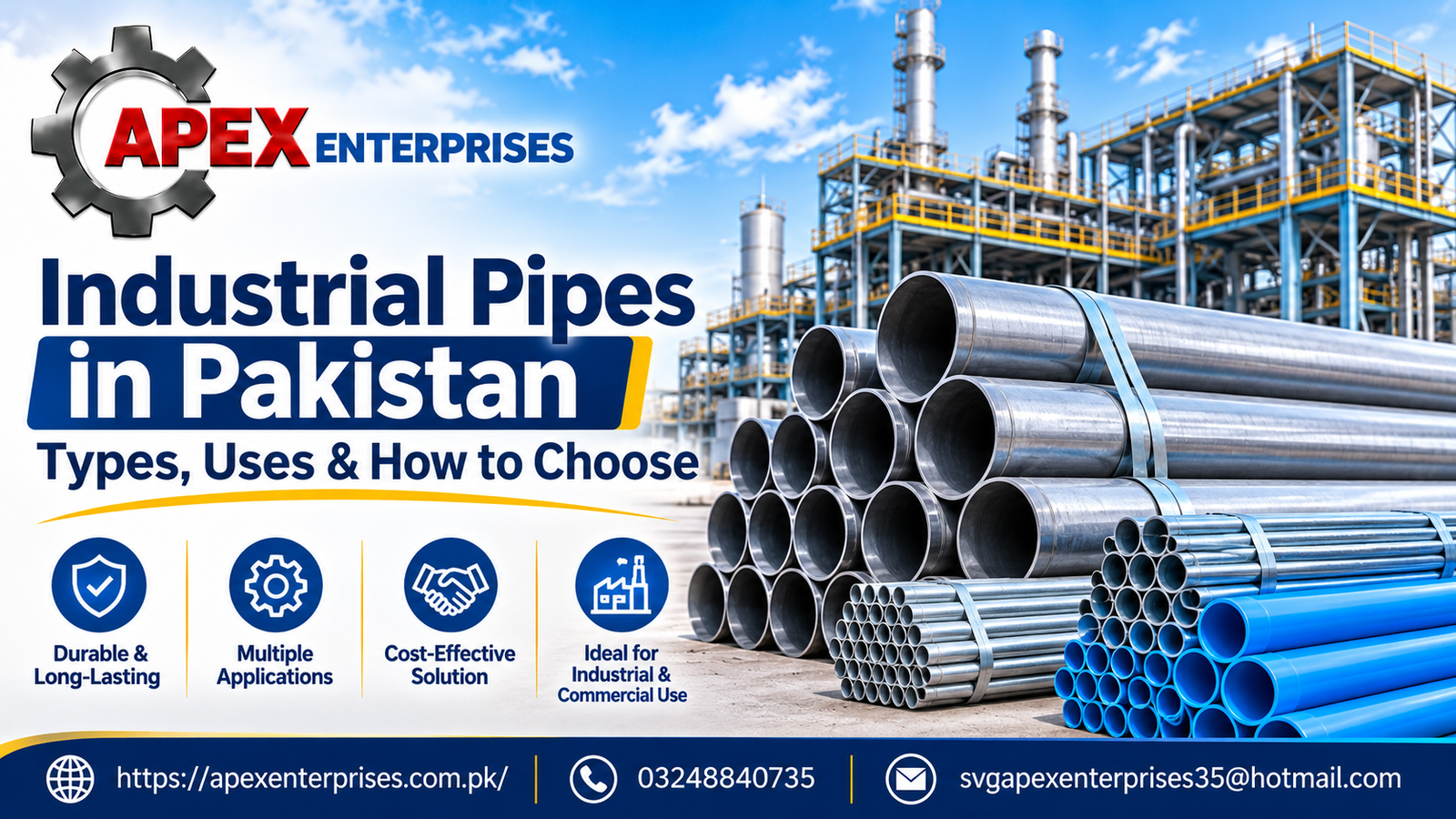
Industrial Pipe Types, Uses and How to Choose the Right One in Pakistan
Industrial pipes in Pakistan carry everything from water and steam to chemicals, oil and gas. Pick the wrong pipe and you risk leaks, early corrosion or a failed pressure test. Pick the right one and the system runs for years with minimal maintenance.
Different jobs call for different materials, sizes and manufacturing methods. For example, a pipe that works on a low-pressure water line can fail fast on a steam or chemical line.
This guide covers the main industrial pipe types, where each one is used and the standards worth knowing. It also explains how to choose both the pipe and the supplier.
What Are Industrial Pipes?
Industrial pipes are tubular components that move liquids, gases and slurries through factories, plants and infrastructure. Household plumbing pipes handle modest pressure and clean water. Industrial pipes, on the other hand, often face high pressure, high temperature, abrasive media or aggressive chemicals.
You can classify them in two ways:
- By material: what the pipe is made of, such as carbon steel, stainless steel or galvanized steel.
- By manufacturing method: how the pipe is made, either seamless or welded.
Keep these two separate. A carbon steel pipe, for instance, can be either seamless or welded.
Industrial Pipe Types by Material
Carbon Steel Pipes (Including Mild Steel)
Carbon steel is one of the most widely used pipe materials in industry. Mild steel is a low-carbon steel, so it belongs to this family. These pipes suit fabrication, structural work, water lines, steam lines and oil and gas systems.
Common standards include ASTM A53 for general-purpose pipe, ASTM A106 for seamless pipe in high-temperature service and API 5L for line pipe. Black carbon steel rusts when exposed to moisture, so outdoor and underground lines need paint, wrapping or another protective coating.
Stainless Steel Pipes
Stainless steel contains at least 10.5% chromium. The chromium forms a thin oxide layer on the surface that resists corrosion. These pipes are common in food processing, pharmaceutical plants and chemical facilities.
Grade matters here. Grade 304 is a general-purpose choice, while 316 contains molybdenum and holds up better against chlorides. ASTM A312 is the usual standard for stainless pipe. So always confirm the exact grade on the quotation, because “stainless steel” alone doesn’t tell you enough.
Galvanized Iron (GI) Pipes
GI pipes are steel pipes coated with zinc. The coating acts as a barrier between the steel and its surroundings. You’ll find them in water distribution, agricultural lines and building utility systems.
The zinc layer can wear down in aggressive water or soil, so coating quality matters. Hot-dip galvanized pipe is covered under ASTM A53. Older specifications refer to BS 1387, which EN 10255 has since replaced.
Industrial Pipe Types by Manufacturing Method
Seamless Pipes
Manufacturers make seamless pipe by piercing and rolling or extruding a solid steel billet, so there’s no longitudinal weld. Engineers often specify seamless pipe for high-pressure and high-temperature service, such as power plants, refineries and boiler lines.
However, seamless construction alone doesn’t guarantee suitability. Material grade, wall thickness and the governing standard still decide whether the pipe fits the job.
Welded Pipes
Manufacturers form welded pipe from steel strip, coil or plate and join the edges by welding. Electric resistance welding (ERW) is typical for small and medium diameters, while submerged arc welding (SAW) is common for larger ones.
Welded pipe is widely available, often costs less and comes in larger diameters. It serves construction, water transport, fabrication and many pressure applications when it meets the specified standard and inspection requirements.
Common Applications of Industrial Pipes in Pakistan
- Construction and infrastructure: structural frames, drainage, water mains and utility lines.
- Oil and gas: gathering lines, processing facilities and distribution networks, where pressure and corrosion control come first.
- Textile and manufacturing plants: water supply, steam distribution, cooling circuits and compressed air.
- Water supply and irrigation: farm networks, tube wells and industrial water systems.
- Chemical and processing plants: corrosion-resistant lines, usually stainless steel, matched to the chemical being handled.
How to Choose the Right Industrial Pipe
- Identify the medium. Water, steam, gas, oil and chemicals each push you toward different materials. Check chemical compatibility before you commit.
- Define pressure and temperature. Get the working and peak values. A pipe rated for cold water isn’t suitable for a steam line.
- Confirm size and wall thickness. Specify nominal pipe size (NPS) or DN, plus the schedule, such as SCH 40 or SCH 80. Wall thickness directly affects pressure capacity.
- Assess the environment. Moisture, outdoor exposure, buried installation and chemical vapors all raise corrosion risk. Plan coatings or a corrosion-resistant material accordingly.
- Follow the project specification. Your drawings or engineer will name the required standard and grade. Match the order to that document exactly.
Pakistan also has its own national standards. You can read about how Pakistan Standards are developed on the PSQCA website.
Industrial Pipes vs Plumbing Pipes
The two can look alike, but they’re built for different duties.
| Comparison | Industrial Pipes | Plumbing Pipes |
| Main purpose | Moving process fluids, steam and gases | Water supply and drainage |
| Typical use | Factories, plants, infrastructure | Homes and commercial buildings |
| Common materials | Carbon steel, stainless steel, GI | PVC, CPVC, PEX, copper |
| Key considerations | Pressure, temperature, chemical compatibility | Water quality, flow, plumbing codes |
| Selection basis | Engineering specifications and standards | Plumbing codes and installation rules |
These are general differences, not strict rules. GI pipe, for instance, shows up in both worlds.
What to Check Before Choosing a Pipes Supplier in Pakistan
A good supplier helps you get the right pipe, not just a price. Before you order, ask for:
- Grade and standard: the exact material grade and the standard it meets, such as ASTM or API.
- Test certificates: a mill test certificate (MTC) for the batch, typically EN 10204 type 3.1, where your project requires one.
- Size and thickness: confirmed diameter, schedule and length, in writing.
- Stock and lead time: actual availability for your quantity and delivery date.
- Bulk capacity: whether the supplier can handle your full order volume.
- Related items: whether they can also supply pipe fittings and valves, so you can source everything together.
For local quality and certification requirements, you can also check the Pakistan Standards and Quality Control Authority (PSQCA).
Industrial Pipe Supply from Apex Enterprises
Apex Enterprises is a Lahore-based general order supplier serving businesses with industrial hardware and procurement needs. If you’re sourcing pipes, send your requirements and the team will help with availability and quotations.
Share these details when you reach out:
- Pipe material and grade
- Diameter, schedule or wall thickness
- Required standard
- Quantity and delivery timeline
You can explore the pipes supplier in Pakistan page for product details, or browse related pipe fittings and valves.
Frequently Asked Questions
What are the most common types of industrial pipes?
The most common types are carbon steel (including mild steel), stainless steel and galvanized iron pipes. Each can be made as a seamless or welded pipe, depending on the application.
Which pipe material is best for industrial use?
No single material wins everywhere. Carbon steel suits many general and high-pressure services, stainless steel suits corrosive environments and GI suits many water applications. Your medium, pressure, temperature and project specification decide.
What’s the difference between seamless and welded pipes?
Seamless pipe has no longitudinal weld and is made from a solid billet. Welded pipe is formed from a strip or plate and joined by welding. Both can meet pressure requirements when they comply with the specified standard.
Is mild steel the same as carbon steel?
Mild steel is a type of carbon steel with low carbon content. Carbon steel is the broader category, which also includes medium- and high-carbon grades.
How do I choose a reliable pipe supplier in Pakistan?
Look for clear grade and standard information, test certificates where needed, confirmed dimensions and realistic lead times. Get everything in writing before you place the order.
Conclusion
Choosing industrial pipes in Pakistan comes down to the basics: the medium, pressure, temperature, environment and the standard your project requires. Separate material from manufacturing method, check grades and certificates, and don’t buy on price alone.
Need pipes for your next project? Contact Apex Enterprises with your specifications and get a quotation.